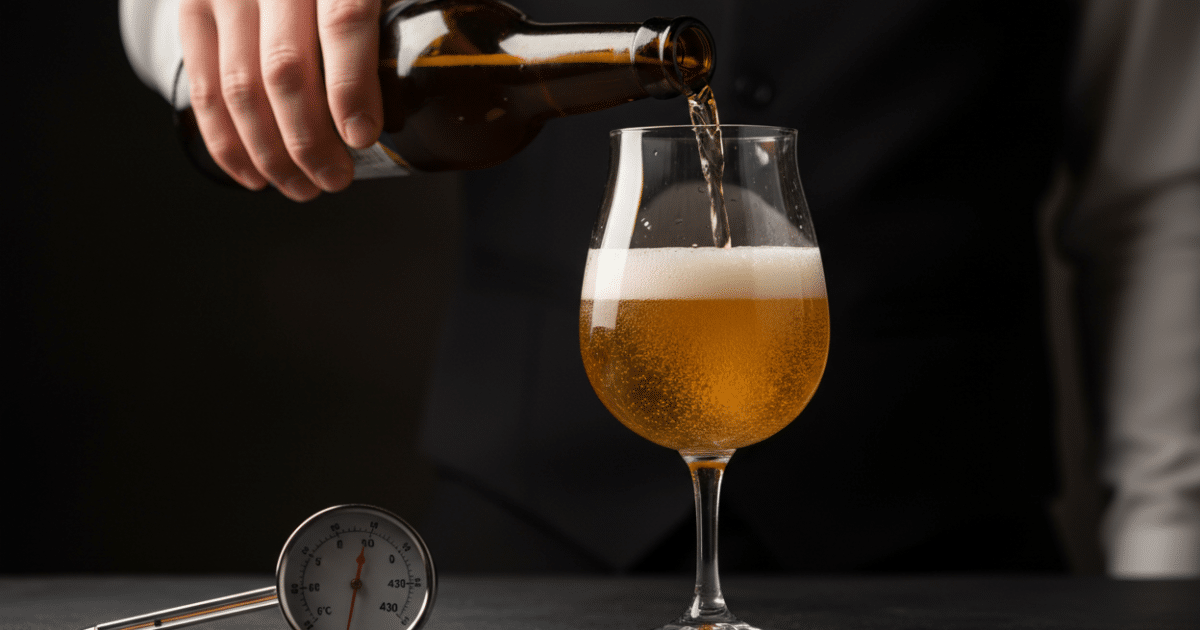
Beer serving temperature is one of the most overlooked variables in the drinking experience — and one of the most consequential. Serve a complex IPA too cold and you flatten its aromatics entirely. Serve a lager too warm and it turns cloying. Getting the temperature right doesn't require a thermometer on the bar, but it does require understanding why it matters in the first place.
The temperature at which you serve beer can transform an ordinary sip into something genuinely memorable — or ruin a well-crafted brew before it reaches its potential. Most drinkers default to "as cold as possible," a habit reinforced by decades of mass-market lager advertising. But that instinct, while understandable, ignores how temperature interacts with carbonation, aroma compounds, and bitterness perception. The science here is straightforward, and the practical adjustments are minor. The payoff, though, is significant.
Temperature directly shapes what you taste and smell
The chemistry of beer is sensitive to heat in ways that affect every sensory dimension of the drink. At lower temperatures, volatile aromatic compounds — the molecules responsible for hop character, yeast esters, and malt complexity — become less active. They don't evaporate as readily from the surface of the liquid, which means they reach your nose in far smaller quantities. The result: a beer that smells like very little and tastes flat, even if the brewing itself was flawless.
Carbonation behaves differently at varying temperatures too. Cold beer holds CO2 more tightly in solution, which produces a sharper, more aggressive carbonation on the palate. That can work in favor of certain styles — a crisp pilsner benefits from that bite — but it overwhelms the subtler flavors of a barrel-aged stout or a Belgian tripel. Warmth releases carbonation more freely, softening the texture and allowing other flavors to emerge.
How bitterness and sweetness shift with temperature
Bitterness perception intensifies as beer warms. The isohumulones derived from hops become more pronounced at higher temperatures, which is why a heavily hopped double IPA served at cellar temperature (around 12-13°C / 54-55°F) can taste almost aggressively bitter. Conversely, sweetness from residual sugars and malt becomes more apparent when the beer is slightly warmer, which is why malty styles like doppelbocks or English barleywines are traditionally served closer to room temperature.
This isn't a matter of preference alone — it's physiology. The human palate registers sweet, bitter, and sour flavors differently depending on the temperature of what it's tasting. Cold suppresses sweetness and amplifies carbonation-driven acidity. Warmth opens up sweetness and reduces the perception of bitterness. Understanding this mechanism is the foundation of serving beer at the right temperature.
Ideal serving temperatures by beer style
There is no single correct answer to what temperature beer should be served at — the right temperature depends entirely on the style. Broad categories provide a useful starting framework, even if individual brewers sometimes specify narrower ranges for their particular products.
Lagers, pilsners, and light ales
These styles are built for cold service. Lagers and pilsners perform best between 3-7°C (38-45°F), where their clean, crisp profiles are at their sharpest. The cold suppresses any off-flavors, highlights carbonation, and delivers the refreshment these beers are designed around. Light ales — American pale ales, Kölsch, wheat beers — sit comfortably in the same range, though the upper end of 6-8°C (43-46°F) allows a bit more aromatic expression without sacrificing drinkability.
Wheat beers deserve a specific mention. A well-made Hefeweizen served at 6-8°C will show its banana and clove esters far more clearly than the same beer served at 2°C from the back of the fridge. That aromatic lift is the whole point of the style.
Ales, IPAs, and amber styles
IPAs — both American and English interpretations — are best served between 8-12°C (46-54°F). Serve them colder and the hop aromatics that define the style become muted. The floral, citrus, and resinous notes that make a well-crafted IPA distinctive only fully express themselves once the beer warms slightly past refrigerator temperature.
Amber ales, red ales, and pale ales follow similar logic, landing comfortably around 10-12°C (50-54°F). At this range, the malt backbone becomes more expressive, the hop bitterness integrates better, and the beer feels more complete on the palate.
Stouts, porters, and strong ales
Dark, complex beers are where serving temperature makes the most dramatic difference. A stout — particularly an imperial or barrel-aged variant — served straight from the fridge at 4°C will taste thin, roasty, and one-dimensional. The same beer at 12-16°C (54-61°F) reveals chocolate, coffee, dried fruit, and vanilla notes that were completely suppressed by the cold.
Guinness, the world's most recognized stout, is traditionally served at around 6°C (42°F) on draught — colder than most stout recommendations, but consistent with its lighter body and nitrogen carbonation. A pint of Guinness has its own specific serving ritual, and temperature is a central part of why it tastes the way it does.
Belgian strong ales, barleywines, and quadrupels sit at the warmest end of the spectrum, often best enjoyed at 14-18°C (57-65°F). These are sipping beers, not drinking beers, and their complexity demands a temperature that allows every layer to breathe.
| Beer Style | Ideal Serving Temperature |
|---|---|
| Lager / Pilsner | 3–7°C (38–45°F) |
| Wheat Beer / Kölsch | 6–8°C (43–46°F) |
| IPA / Pale Ale | 8–12°C (46–54°F) |
| Amber / Red Ale | 10–12°C (50–54°F) |
| Stout / Porter | 12–16°C (54–61°F) |
| Belgian Strong / Barleywine | 14–18°C (57–65°F) |
Practical methods for serving beer at the right temperature
Knowing the target temperature is one thing. Getting there without a dedicated cellar or commercial draft system is another. But the adjustments needed at home are simpler than most people assume.
Cooling beer correctly
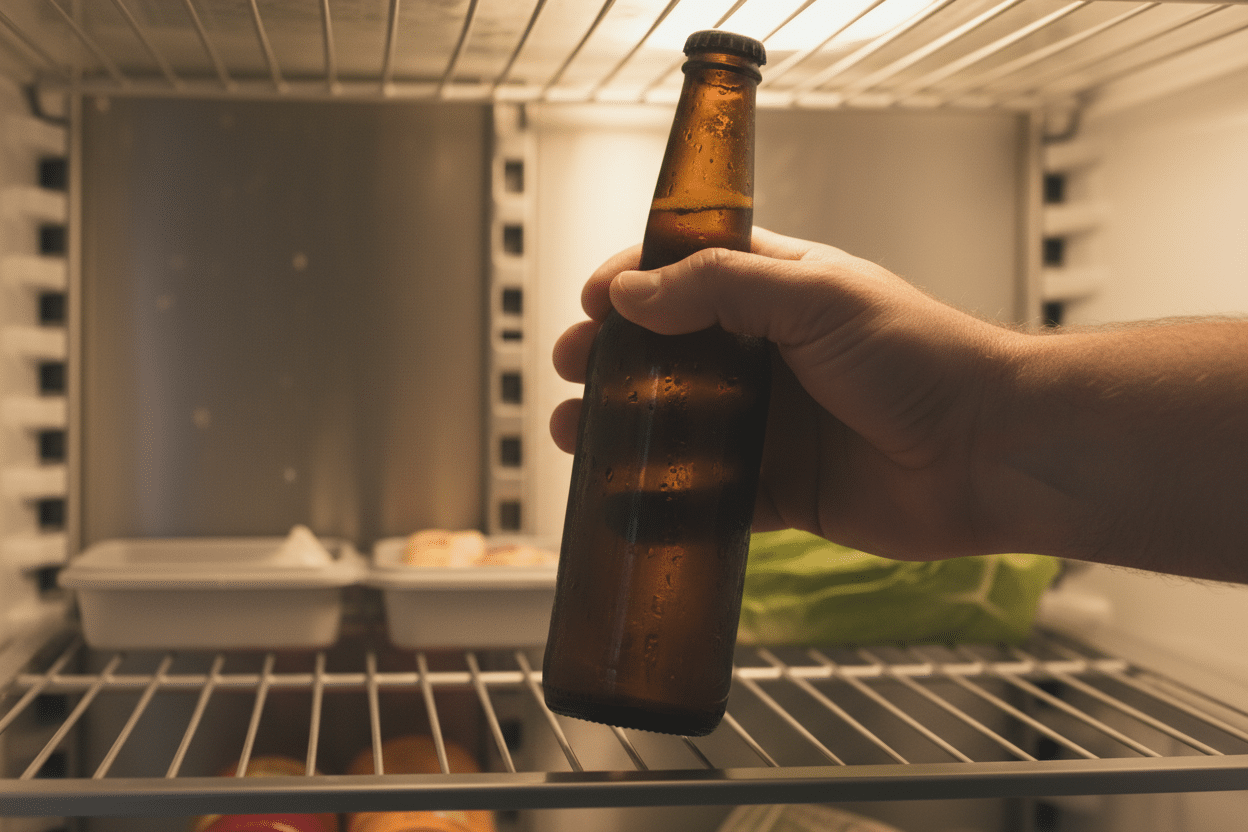
A standard household refrigerator runs at 2-4°C (35-40°F) — fine for lagers and pilsners, but too cold for almost everything else. The practical solution is to pull the beer out of the fridge 15 to 30 minutes before serving, depending on the style. An IPA needs roughly 20 minutes on the counter to reach its optimal range. A barleywine might need 45 minutes to an hour.
A wine cooler or dedicated beer fridge with adjustable temperature settings is worth considering for serious enthusiasts. These allow you to store different styles at their respective optimal temperatures without constant adjustment.
Warming beer without ruining it
Never use a microwave or direct heat. The goal is gentle, passive warming at room temperature. For bottles stored in a cellar or cold garage, bring them indoors and let them rest upright. For cans or bottles from the fridge, a simple counter rest does the job. The key is patience — rushing the process by wrapping a bottle in warm water risks uneven temperature distribution and can agitate the carbonation.
A chilled glass will lower the temperature of a properly warmed beer within minutes. If you’re serving a complex ale or stout at the right temperature, use a room-temperature glass — not one pulled from the freezer.
The glassware itself is a meaningful variable. A frozen mug will drop a beer's temperature by several degrees almost immediately. For styles that benefit from warmer service, this works directly against the goal. A room-temperature glass maintains the beer's serving temperature through the first half of the drink, which is when most of the aromatic experience happens.
Common mistakes that undermine the beer serving experience
The "colder is better" assumption is the single most widespread error in beer service, and it's understandable — cold masks flaws, and mass-market beers are often better cold for exactly that reason. But applying that logic to a Belgian saison, a smoked porter, or an English bitter destroys what makes those beers worth drinking.
Freezer storage and temperature shock
Storing beer in the freezer — even briefly — is a mistake. Below 0°C, the water in beer begins to crystallize, which can alter the structure of certain compounds and affect carbonation when the beer returns to liquid form. More practically, beer forgotten in the freezer expands and either loses its carbonation or, in worst cases, bursts. A short stint in the freezer to quick-chill a warm beer occasionally won't cause permanent damage, but it's a habit worth avoiding.
Temperature fluctuation is a separate concern. Repeatedly warming and cooling beer degrades it faster than consistent storage at a slightly higher temperature would. A beer stored consistently at 10°C will keep better than one cycling between 4°C and 20°C every few days.
Ignoring the glass temperature
Chilled glasses are standard at many bars, and for lagers, they're appropriate. But serving a nuanced craft ale into a frosted glass is a genuine waste of the beer. The frost on the glass signals temperatures well below 0°C, which immediately pulls the beer's temperature down and shuts down its aromatics. For the same reason, pouring a complex beer over ice — unless it's specifically designed as a base for a cocktail, the way you might approach a shandy or a beer-based punch — is a category error.
Frosted glasses are appropriate for light lagers only. Using them for ales, stouts, or any complex craft beer will suppress aromatics and flatten the tasting experience within the first few minutes of the pour.
Temperature shapes the entire arc of a tasting experience
The beer serving temperature doesn't just affect the first sip — it determines how the beer evolves over the course of a glass. A beer poured at the right temperature will warm slightly as you drink it, and for many styles, this progression is intentional. A well-structured imperial stout poured at 13°C might open up into richer, more complex territory by the time you reach the bottom of the glass. That evolution is part of the experience.
This is why the concept of the ideal serving temperature is better understood as a starting point rather than a fixed target. Serious tasters often pour slightly below the target temperature and allow the beer to warm into its optimal range over the first few minutes. It's the same logic applied to wine service, and it works just as well with beer.
The parallel with other drinks is worth drawing. Just as you'd think carefully about temperature when preparing a rum punch or a strawberry daiquiri — where ice dilution and ingredient temperature affect the final balance — beer service rewards the same attention. Temperature is not a secondary consideration. It's a fundamental part of how flavor is delivered. Getting it right is the simplest upgrade most beer drinkers can make, and it costs nothing beyond a bit of patience and a willingness to pull the bottle out of the fridge a few minutes earlier than usual.