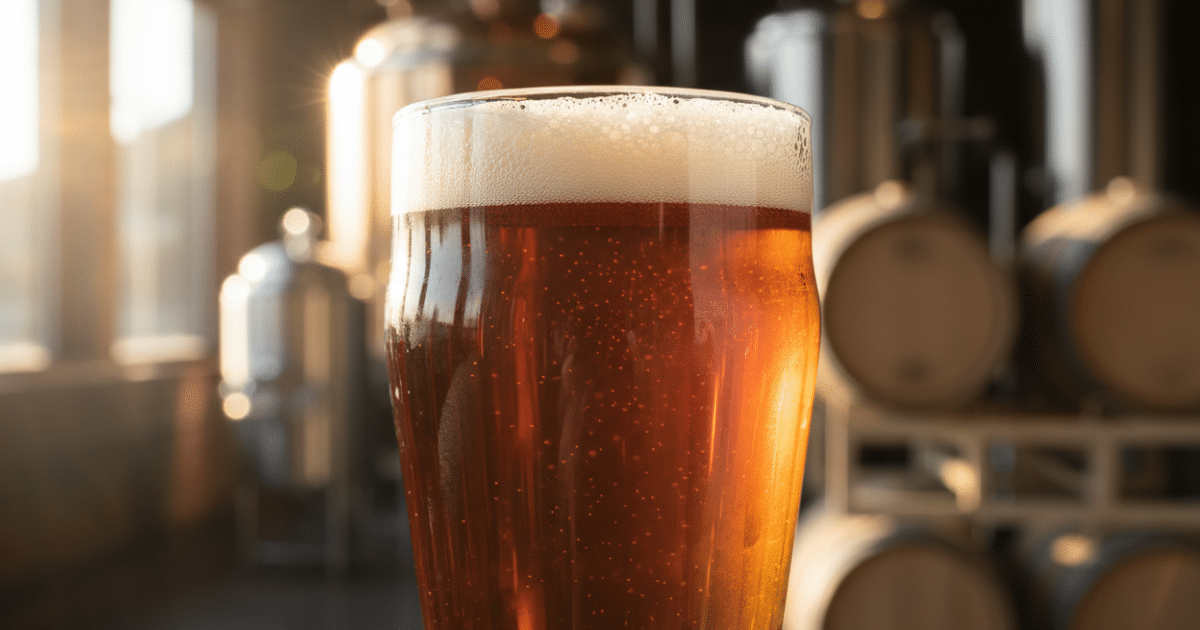
India Pale Ale is not just a beer style — it's a direct product of empire, trade routes, and the brewer's obsession with preservation. Understanding what IPA beer actually is means tracing a lineage from 18th-century English brewhouses to the craft beer revolution that reshaped drinking culture worldwide. The hops are the story. Everything else follows.
The term "India Pale Ale" gets thrown around constantly in tap rooms and bottle shops, often reduced to a shorthand for "bitter and hoppy." But that reduction misses the point entirely. The India Pale Ale has one of the most documented and debated origin stories in all of brewing, a flavor profile that spans from delicate tropical fruit to aggressive resinous pine, and a range of sub-styles so diverse they practically constitute separate categories. This is a beer style worth understanding properly.
The origins of India Pale Ale go deeper than the colonial myth
The standard story is clean and satisfying: British brewers in the late 18th century needed to ship beer to soldiers and administrators posted in India. The voyage around the Cape of Good Hope took six months or more, and most beers arrived spoiled. The solution was to brew a stronger, heavily hopped pale ale — hops being a natural preservative — that could survive the journey. By the time the barrels reached Calcutta, the beer had matured into something exceptional.
That narrative is not entirely wrong, but it is simplified. Historians of brewing, including Martyn Cornell, have challenged the idea that IPA was invented specifically for export. Pale ales were already being heavily hopped in England for domestic consumption. The East India Company trade did play a role in the style's commercial spread, but the "born to survive the tropics" origin story was largely a marketing construction that emerged much later.
George Hodgson and the Bow Brewery
The name most associated with early IPA is George Hodgson of the Bow Brewery in London. From the 1780s onward, Hodgson supplied pale ales to ships departing for India, and his product built a loyal following among British expatriates. The geographical proximity of his brewery to the East India docks gave him a logistical advantage that competitors could not easily match.
By the 1820s, Burton-on-Trent brewers — particularly Bass and Allsopp — entered the India export market with their own versions. The hard, sulfate-rich water of Burton produced a pale ale with exceptional clarity and a crispness that ultimately surpassed Hodgson's product in popularity. This Burton style became the template for what most people now recognize as a classic English IPA.
The decline and American resurrection
IPA nearly disappeared in the 20th century. Two World Wars brought grain rationing and government restrictions on alcohol strength. The style contracted, merged with ordinary pale ale, and was largely forgotten in its original market. What saved it was American craft brewing. Brewers in California and the Pacific Northwest, starting in the 1980s, rediscovered the style and rebuilt it using aggressive American hop varieties. The result was something both historically connected and entirely new.
The flavor profile of IPA is defined by hops, not just bitterness
Ask someone who doesn't drink IPA why they avoid it, and the answer is almost always "too bitter." That perception is outdated and, frankly, inaccurate for a large portion of the style's current output. Bitterness is one dimension of IPA. Aroma, flavor, and mouthfeel are the others, and they are where the real complexity lives.
IBU stands for International Bitterness Units, the scale used to measure perceived bitterness in beer. A standard lager sits around 10–15 IBU. A classic West Coast IPA typically ranges from 50 to 70 IBU. Some Double IPAs exceed 100 IBU, though human perception plateaus well before that point.
Hops: the defining ingredient
Hops (Humulus lupulus) are the flowers of a climbing plant, and they serve two distinct functions in brewing: bittering and aroma. Hops added early in the boil contribute bitterness as their alpha acids isomerize. Hops added late — during whirlpool, dry-hopping, or conditioning — contribute volatile aromatic compounds that dissipate quickly if exposed to heat. This is why dry-hopped IPAs can smell intensely of mango, citrus, or pine while delivering a softer bitterness than their aroma suggests.
American hop varieties transformed the style. Cascade, developed in 1972, brought the grapefruit and floral character that defined early American IPA. Centennial, Citra, Mosaic, and Simcoe followed, each carrying distinct aromatic profiles ranging from tropical fruit to dank, resinous cannabis-like notes. These varieties gave American craft brewers a palette that English brewing simply did not have.
Malt and fermentation
Malt provides the structural backbone — the sugars that yeast ferments into alcohol, and the residual sweetness that balances hop bitterness. Classic IPAs use pale malt as the base, sometimes with small additions of crystal malt for color and a subtle caramel note. The goal is a clean, relatively light malt character that lets hops dominate without disappearing entirely. Push the malt too hard and you get a barleywine. Suppress it entirely and the beer becomes thin and harsh.
Yeast selection matters more than most casual drinkers realize. A neutral American ale yeast keeps the fermentation character clean and lets hop aromatics shine. English strains contribute fruity esters that complement the hop profile in traditional styles. The New England IPA took this further by using yeast strains that produce significant amounts of biotransformation compounds, chemically transforming hop compounds during fermentation into new aromatic molecules.
The IPA family now spans radically different styles
What started as a single export ale has fractured into a constellation of sub-styles, each with its own technical specifications and devoted following. The differences are not cosmetic — they reflect genuinely distinct brewing philosophies and flavor targets.
- Clear, filtered appearance
- Dry finish with assertive bitterness
- Resinous, piney, citrus-forward aroma
- Lower residual sweetness
- Hazy, unfiltered appearance
- Soft, pillowy mouthfeel
- Intense tropical fruit aroma
- Lower perceived bitterness despite high hop load
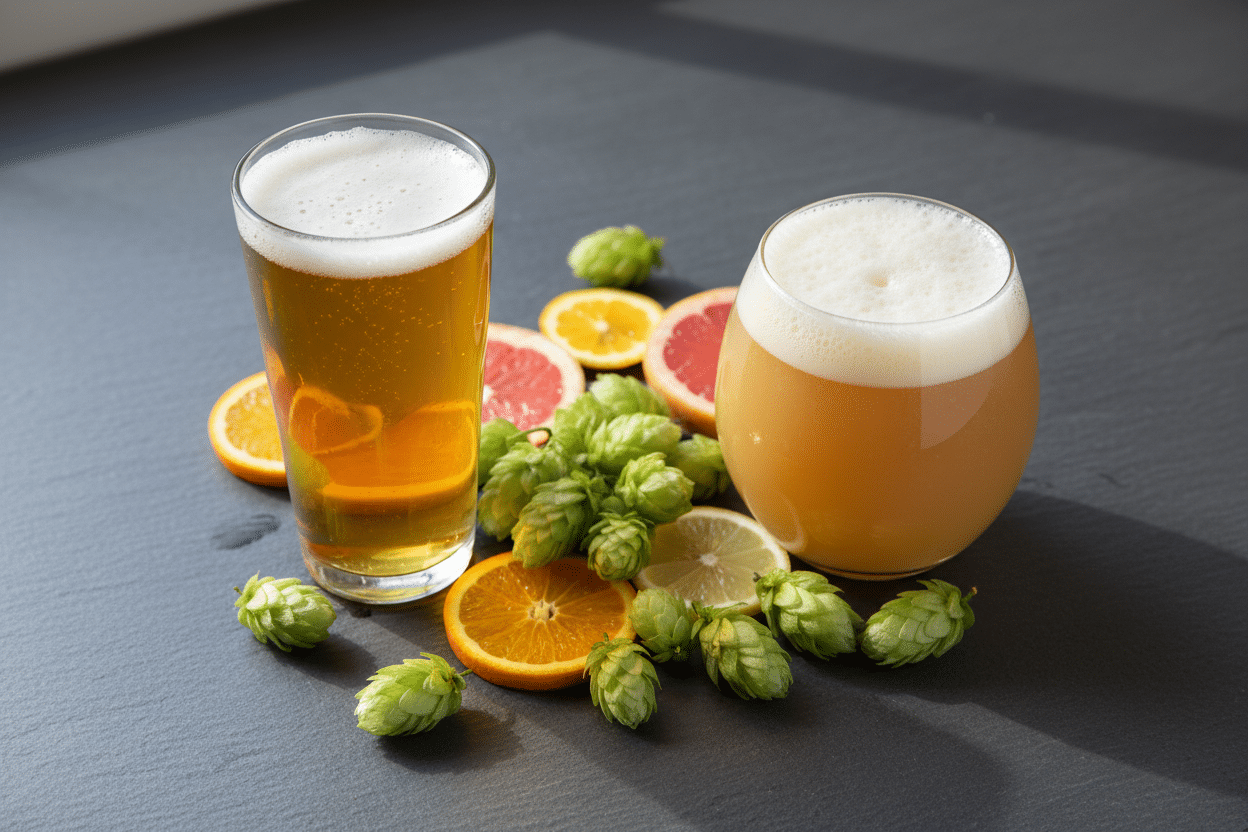
The West Coast IPA is the style that defined American craft beer in the 1990s and 2000s. Dry, bitter, transparent, and aggressively hopped with resinous American varieties — breweries like Ballast Point, Stone Brewing, and Russian River built their reputations on it. The New England IPA (NEIPA) emerged from the Northeast, pioneered by breweries like The Alchemist in Vermont with their Heady Topper release in 2004. The NEIPA prioritizes aroma intensity and soft mouthfeel over bitterness, using oats and wheat for body and massive late-hop additions for juicy fruit character.
Beyond these two dominant styles, the IPA family includes Session IPAs (lower alcohol, typically under 4.5% ABV, designed for extended drinking), Double or Imperial IPAs (higher gravity, 7.5% ABV and above, amplifying both bitterness and aroma), Black IPAs (roasted malt character combined with aggressive hopping), and Milkshake IPAs (lactose addition for sweetness and body, often combined with fruit adjuncts). Each represents a different answer to the question of what IPA can be.
Food pairings with IPA reward deliberate thinking
The bitterness and aromatic intensity of India Pale Ale make it one of the most food-versatile beer styles, but the pairing logic differs from wine. Where wine often seeks harmony, IPA frequently works best through contrast or complementarity with fat and spice.
Pairing with spicy and bold flavors
Spicy food is where IPA earns its place at the table. The carbonation cuts through fat and coats the palate, while the hop bitterness amplifies the perception of heat — which is either a feature or a warning, depending on your tolerance. Thai green curry, Mexican birria, and Indian vindaloo all find a willing partner in a well-hopped IPA. The floral and citrus aromatics in the beer echo spice-forward cuisines in a way that lager simply cannot.
Grilled and charred food is another natural territory. The Maillard reaction compounds in a charred burger or grilled chicken interact with the roasty, resinous notes of a West Coast IPA in a way that genuinely elevates both. This is not theory — it is a pairing that works consistently across different cooking contexts.
Cheese and charcuterie
Strong, aged cheeses — particularly washed-rind varieties and aged cheddars — hold up to IPA's intensity without being overwhelmed. The fat in the cheese tempers the bitterness, while the hop aromatics cut through the richness. Blue cheese is a classic match: the funk and salt of the cheese contrast sharply with the citrus and pine of the beer, creating a combination more interesting than either component alone.
Just as you might consider the interplay of flavors when crafting a rum punch for a summer gathering, the same deliberate thinking applies to IPA pairings — balance between intensity and refreshment is the governing principle.
IPA's role in craft beer culture goes beyond trend status
The India Pale Ale became the flagship of the craft beer movement not by accident but because it offered something that mass-market lager fundamentally could not: flavor complexity that rewarded attention. When the American craft brewing scene began its serious expansion in the 1990s, IPA became the style that communicated seriousness. Ordering an IPA was a statement of intent.
That symbolic weight has consequences. IPA now accounts for a disproportionate share of craft beer sales in the United States — estimates consistently place it above 25% of craft beer dollar sales, making it the single most commercially dominant style in the segment. Breweries that do not produce a credible IPA are operating at a commercial disadvantage.
of US craft beer dollar sales attributed to IPA styles
The beer festival circuit reflects this dominance. Events like the Great American Beer Festival in Denver receive thousands of IPA entries across multiple sub-categories, a volume that no other style approaches. The judging categories themselves have multiplied to accommodate the style's expansion — what was once a single IPA category now encompasses West Coast, American, Hazy/Juicy, Imperial, Session, and Specialty sub-categories.
This cultural centrality has also generated a genuine counter-reaction. A segment of craft beer drinkers and brewers has pushed back against what they see as IPA monoculture, advocating for lagers, sours, and traditional European styles. The debate is healthy. But the IPA's position as the defining style of modern bière artisanale culture is not seriously in question.
Just as the calorie content of a pint of Guinness reflects the specific character of that stout tradition, IPA's nutritional and sensory profile reflects its own brewing logic — high hop load, moderate to elevated alcohol, and a flavor intensity that makes it one of the most immediately identifiable beer styles in any glass. Understanding what India Pale Ale beer is means accepting that it is not one thing, never was, and continues to evolve in directions that even its most enthusiastic proponents did not anticipate thirty years ago.