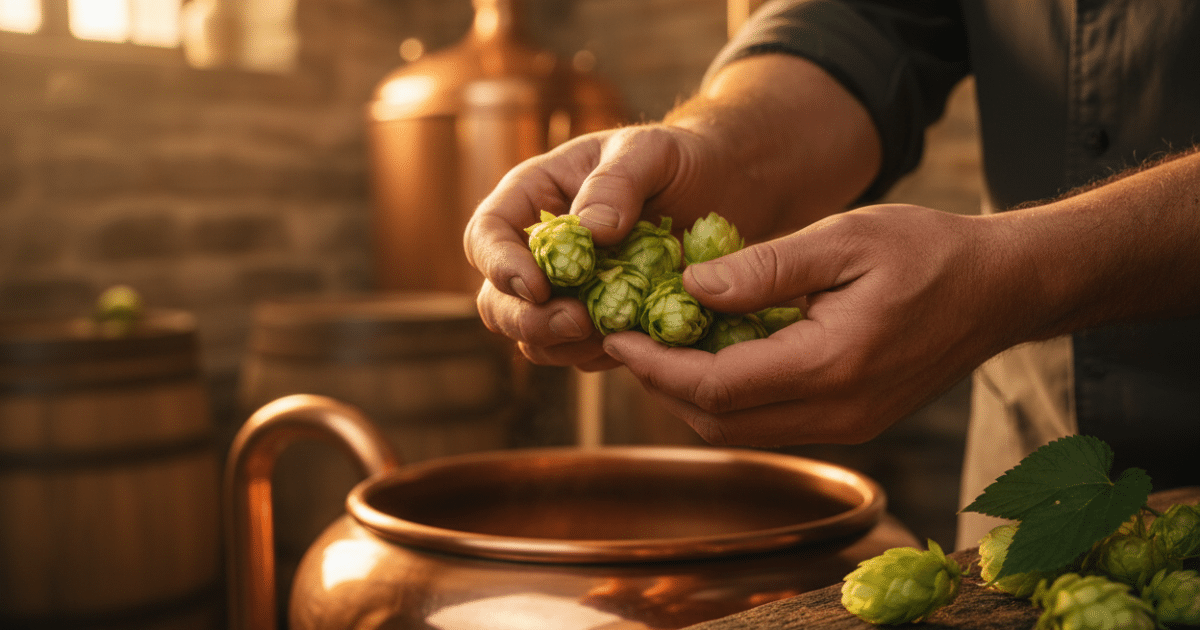
Hops are the cone-shaped flowers of Humulus lupulus, a climbing plant that gives beer its bitterness, aroma, and stability. Without them, most modern beer styles simply wouldn't exist. Understanding hop varieties and how they're used during brewing is the key to decoding why two IPAs can taste completely different — or why a lager feels so clean and crisp.
Hops are often called the spice of beer, and the comparison holds up. Just as a chef selects herbs to define a dish, a brewer chooses hop varieties to shape every sensory dimension of the final product. Bitterness, floral notes, citrus, pine, earthy depth — all of it traces back to decisions made around the hop addition schedule. Yet despite their central role, hops remain one of the least understood ingredients among casual beer drinkers.
This article breaks down what hops actually are, which varieties matter most, how timing in the brew kettle changes everything, and where hop innovation is heading right now.
What hops are and why they matter in brewing
Hops (Humulus lupulus) belong to the Cannabaceae family, making them botanical cousins of cannabis. The part used in brewing is the female flower, also called a cone or strobile. These cones are packed with lupulin glands, tiny yellow structures that contain the resins and essential oils responsible for bitterness and aroma.
The plant itself is a vigorous perennial vine, capable of growing up to 6 meters in a single season. Commercial hop cultivation requires specific climates — cool winters, warm summers, and long daylight hours. The world's major hop-growing regions cluster around the 45th to 50th parallel north: the Yakima Valley in Washington State, the Hallertau region in Bavaria, and the Saaz-growing areas of the Czech Republic. New Zealand and Australia have carved out their own identity more recently, producing distinctly Southern Hemisphere profiles.
The chemistry behind the flavor
Inside those lupulin glands, two categories of compounds define what hops do to beer. Alpha acids (humulones) are the primary source of bitterness. They're not bitter in their raw form — they need to be isomerized through boiling, a process called isomerization, before they contribute the characteristic bitterness measured in IBUs (International Bitterness Units). The longer and harder the boil, the more alpha acids convert, and the more bitter the beer becomes.
Beta acids and essential oils, on the other hand, drive aroma and flavor. Compounds like myrcene, linalool, geraniol, and farnesene create the citrus, floral, spicy, and fruity notes that define hop-forward styles. These volatile oils evaporate quickly under heat, which is why brewers add aroma hops late in the process or after fermentation entirely.
IBU (International Bitterness Unit) measures the concentration of isomerized alpha acids in beer. A light lager typically sits between 8–12 IBU, while a double IPA can exceed 100 IBU — though perceived bitterness also depends heavily on the beer’s residual sweetness and malt backbone.
The major hop varieties and their flavor profiles
Not all hops are interchangeable. Each variety carries a distinct chemical fingerprint that shapes the beer's flavor profile in predictable ways. Brewers broadly divide hops into three functional categories: bittering hops (high alpha acids, neutral aroma), aroma hops (delicate oils, lower alpha content), and dual-purpose hops (useful for both).
Noble hops and their European heritage
The term "noble hops" refers to four traditional Central European varieties: Saaz, Hallertauer Mittelfrüh, Tettnanger, and Spalt. These are low-alpha, high-aroma varieties characterized by soft, spicy, and herbal notes. Saaz, grown in the Bohemian region of the Czech Republic, defines the profile of classic Czech Pilsners — that clean, slightly earthy, almost chamomile-like bitterness that makes a Pilsner Urquell recognizable. Hallertauer brings a more floral, slightly fruity quality that anchors traditional German lagers and wheat beers.
These varieties are notoriously difficult to grow and relatively low-yielding, which keeps them expensive. But their subtlety is irreplaceable in lager styles where hop character needs to complement rather than dominate.
American and New World varieties
American hop breeding has been the most aggressive in the industry over the past four decades. Varieties like Cascade, Centennial, Chinook, and Citra transformed what beer could smell and taste like. Cascade, released in 1972 by the USDA, introduced American craft brewing to grapefruit and floral aromas — it's still the backbone of countless American Pale Ales and the original Sierra Nevada Pale Ale.
Citra, developed by the Hop Breeding Company and released in 2008, took things further with intense tropical fruit notes: passionfruit, mango, lime. It became the defining hop of the modern New England IPA style. Similarly, Mosaic (released in 2012) offers blueberry, tropical, and earthy complexity that makes it one of the most versatile dual-purpose hops available.
New Zealand varieties like Nelson Sauvin bring something genuinely different: a white wine, gooseberry character that doesn't exist in European or American hops. Galaxy, from Australia, delivers passionfruit and peach with high oil content, making it a favorite for late additions and dry hopping.
- Intense, distinctive fruit and citrus aromas
- High alpha acid content — efficient for bittering
- Versatile across many modern styles
- Strong identity in dry-hopped beers
- Lower alpha acids — require larger quantities for bitterness
- More delicate, can get lost in complex malt bills
- Higher cost due to lower yields
- Less suited to hop-forward styles like IPA
How hop additions during brewing shape the final beer
Timing is everything in hop usage. The same variety added at different points in the brewing process produces radically different results. This is one of the most misunderstood aspects of craft beer — and one of the most powerful tools a brewer has.
Bittering additions: the 60-minute boil
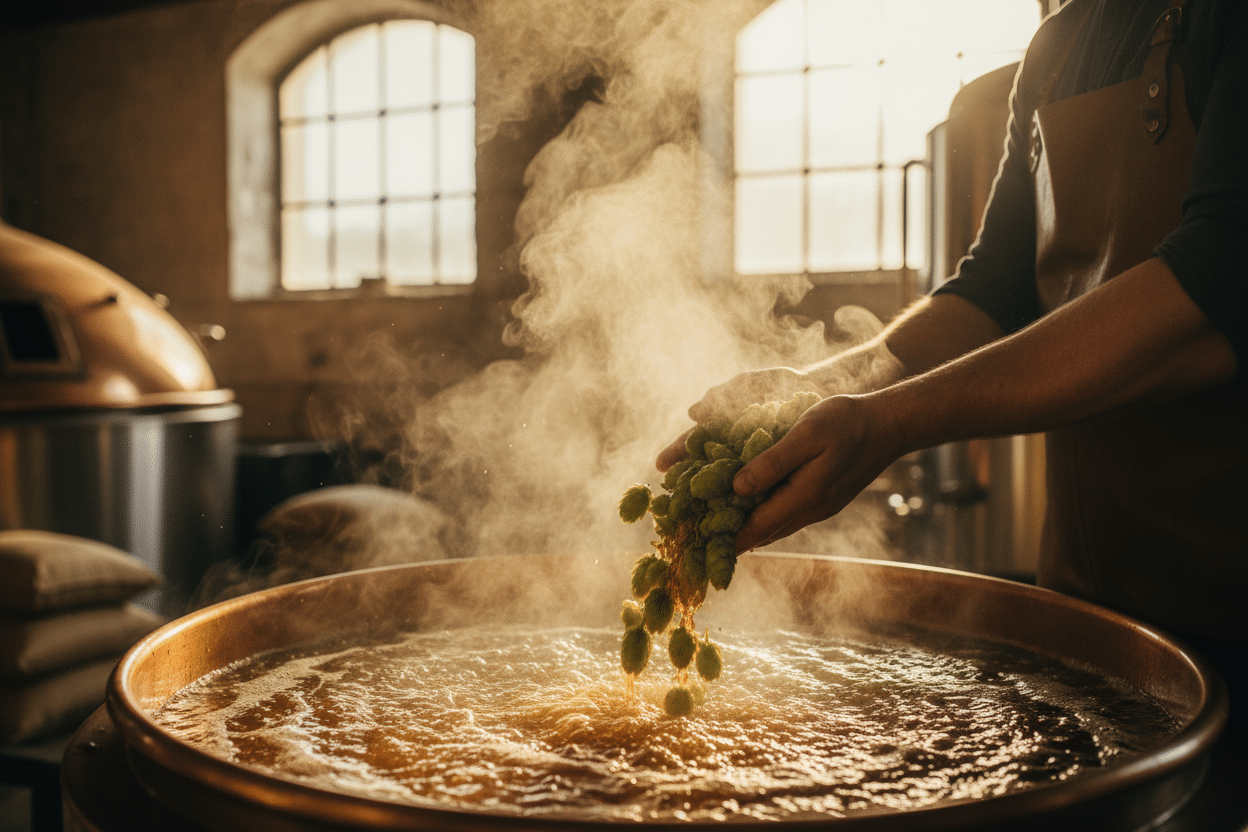
Hops added at the start of the boil — typically 60 minutes before the end — are there purely for bitterness. The extended heat exposure isomerizes the alpha acids, extracting maximum bitterness while driving off nearly all aromatic compounds. These are often cheap, high-alpha varieties like Magnum or Columbus, chosen for their efficiency and neutral flavor contribution. The goal here is structural: establishing the bitterness that balances the malt's sweetness.
Some brewers use a technique called first wort hopping, adding hops to the kettle as the wort is being collected before the boil even starts. This produces a softer, more integrated bitterness compared to standard 60-minute additions.
Late additions and whirlpool hopping
Hops added in the last 10 to 15 minutes of the boil, or at flame-out, preserve more volatile aromatic oils. The wort is still hot enough to extract oils but not hot enough to fully volatilize them. This is where flavor and aroma hops shine.
Whirlpool hopping (also called hot-side aroma or hop stand) takes this further. After the boil, the wort is circulated in a whirlpool to separate hop material, and additional hops are steeped at temperatures around 80–85°C. This temperature range is ideal for extracting aromatic compounds while minimizing harsh bitterness — it's a technique that transformed hazy IPA brewing.
Dry hopping: cold-side aroma intensity
Dry hopping means adding hops directly to the fermenter, either during or after fermentation, without heat. No bitterness is extracted — only raw aromatic oils transfer into the beer. The result is the intensely fresh, juicy, almost "hop juice" character that defines New England IPAs and West Coast IPAs alike.
Dry hop rates have escalated dramatically in craft brewing. Some commercial NEIPAs use 500 grams of hops per hectoliter or more, a rate that would have seemed absurd 20 years ago. The technique requires careful oxygen management, since dry hops can introduce oxygen that stales the beer.
Just as a bartender's craft extends beyond the obvious — knowing that the balance of sweetness, acidity, and dilution defines a cocktail the way bitterness and aroma define a beer — hop selection and timing are the brewer's equivalent of recipe precision. The same logic applies whether you're crafting a rum punch or a double IPA: ingredients matter, but so does when and how you use them.
The functional benefits hops bring to beer beyond flavor
Hops do more than taste good. Their role in beer stability is historically and technically significant, and it's part of why they replaced other bittering herbs in European brewing during the 15th and 16th centuries.
Natural preservation and antimicrobial properties
The iso-alpha acids produced during boiling have documented antimicrobial properties. They inhibit the growth of gram-positive bacteria, including Lactobacillus species that can spoil beer. Before refrigeration, this was a practical necessity. India Pale Ale's legendary hop load wasn't just about taste — it was about keeping beer drinkable on the months-long voyage from England to India.
Modern brewers still rely on this effect. Highly hopped beers have longer shelf lives and greater resistance to bacterial contamination. This is one reason why lightly hopped styles like wheat beers and session ales require stricter sanitation protocols.
Foam stability and body
Hop-derived proteins, specifically iso-alpha acids, interact with malt proteins to improve foam stability. A well-hopped beer holds its head longer and produces a more persistent lace on the glass. This is a physical property that affects the drinking experience in ways that go beyond flavor — though it's rarely discussed outside professional brewing circles.
Hops also contribute to the perceived body and mouthfeel of beer, particularly in dry-hopped styles where high oil content adds a slight viscosity and texture. This is part of why a heavily dry-hopped NEIPA feels fuller and rounder than a similarly alcoholic lager.
When reading a beer label, “IBU” tells you about bitterness from alpha acid isomerization, but it says nothing about aroma intensity. A beer with 70 IBU and late hop additions will taste very different from one with 70 IBU from early bittering additions only. Always look for dry-hop or whirlpool mentions if aroma is what you’re after.
Current trends and innovations in hop cultivation and use
The hop industry is moving fast. Between climate pressures on traditional growing regions, new breeding programs, and brewing techniques borrowed from other fermented beverages, the landscape of hop innovation looks nothing like it did a decade ago.
New breeding programs and experimental varieties
The USDA, Hop Breeding Company, and European research institutions are releasing new varieties at an unprecedented pace. Experimental hops (labeled with codes like HBC 586 or ADHA series) are trialed by craft breweries before official release, creating buzz and exclusivity around single-batch beers. Many of these newer varieties target specific aroma profiles — stone fruit, tropical, berry — while also improving disease resistance and yield for farmers.
Breeding for low-cohumulone content is another priority. Cohumulone, one of the alpha acid fractions, tends to produce a harsher bitterness. Varieties engineered with lower cohumulone percentages deliver smoother bitterness, which is increasingly valued in modern brewing.
Cryo hops, hop extracts, and biotransformation
Cryo hops are produced by cryogenically separating lupulin from the vegetative material of the hop cone. The result is a concentrated powder with roughly double the oil and resin content of standard pellets. Brewers use them for late and dry additions where maximum aroma impact with minimal vegetative astringency is the goal.
Hop extracts — CO2 or isomerized alpha acid extracts — allow precise bitterness addition without bulk. They're standard in large-scale commercial brewing but increasingly adopted by craft producers for consistency.
Perhaps the most exciting frontier is biotransformation: the interaction between active yeast and dry hops during fermentation. Certain yeast strains contain enzymes (notably beta-glucosidases) that cleave hop glycosides, releasing aromatic compounds that wouldn't otherwise be expressed. This is part of why the same hop variety can produce dramatically different aromas in a NEIPA fermented with a specific London Ale yeast versus a neutral American strain. The beer's final aroma profile becomes a product of both the hop variety and the yeast's metabolic activity — a complexity that keeps pushing craft brewing forward.
Beer, at its best, rewards the same attention to ingredient quality and technique that defines any serious culinary tradition. Just as understanding the balance of a strawberry daiquiri requires knowing how each component contributes to the whole, reading a hop bill requires understanding what each variety and addition point actually does. That knowledge is what separates a thoughtful beer drinker from one who just picks whatever's cold.