
Soft-boiled eggs in the air fryer come out perfectly runny every time — as long as you respect the right temperature and timing. At 180 °C for 6 to 7 minutes, you get a firm, opaque white and a yolk that flows freely. Miss by a minute or two, and you've got a hard-boiled egg instead.
The air fryer has quietly become one of the most reliable tools in the modern kitchen. Most people use it for fries or chicken wings, but it handles eggs with surprising precision. And for anyone who has ever pulled a hard-boiled egg out of a pan when they wanted a runny yolk, that precision matters.
Cooking a soft-boiled egg — defined by its fully set, opaque white and its liquid, flowing center — has always been a race against time. On the stovetop, 4 to 6 minutes in simmering water is the standard window. But the margin for error is slim. A distracted moment, a flame that runs too hot, and the yolk sets completely. Résultat: a hard-boiled egg, where both white and yolk are entirely firm. Not what you were after.
The air fryer solves the timing problem
The appeal of the air fryer soft-boiled egg is control. Hot air circulates at a consistent temperature around each egg, removing the variables that make stovetop cooking unpredictable. No boiling water temperature fluctuations, no guessing when the simmer is just right.
The high-heat method: 180 °C
This is the go-to approach for a runny yolk. Place the eggs directly in the basket at 180 °C and cook for 6 minutes if you want the yolk to flow freely — a proper liquid center. Add one minute, so 7 minutes total, and you get something slightly creamier, still soft but with more body. Cuisine Actuelle specifically recommends 7 minutes at 180 °C as the reliable benchmark for a classic soft-boiled result.
The difference between 6 and 7 minutes is not academic. Everything hinges on that single minute. At 6 minutes, the yolk runs. At 7 minutes, it holds its shape slightly while remaining soft. Beyond that, you're heading toward a hard-boiled egg.
The gentle method: 130 °C
For a different texture altogether — a white that is almost custardy and tender rather than firm — drop the temperature to 130 °C and extend the cooking time to 9 to 10 minutes. This low-and-slow approach produces a noticeably softer white, which some people prefer, especially when pairing the egg with delicate toppings.
Never stack eggs on top of each other in the air fryer basket. A single layer is the rule — hot air needs to circulate freely around every egg to cook them evenly.
Preparation makes or breaks the result
The cooking time is only part of the equation. Two steps before and after the air fryer determine whether the egg actually turns out the way you want.
Take the eggs out of the fridge early
Cold eggs behave differently than room-temperature eggs in a hot environment. The outer white cooks faster than the cold center can catch up, leading to uneven results. The fix is simple: remove the eggs from the refrigerator at least 30 minutes before cooking and let them come to room temperature. Then place them directly in the air fryer basket — no preheating, no water, no rack needed.
The ice bath is non-negotiable
Once the timer goes off, the eggs do not stop cooking on their own. Residual heat continues working through the shell. The only way to stop the process and lock in that liquid yolk is to plunge the eggs immediately into very cold, ideally ice-cold, water for a few minutes. Skip this step and the yolk will keep setting while you're peeling. It's a small thing that changes everything.
If you skip the cold water bath after cooking, the residual heat inside the shell will continue cooking the yolk. Even a perfectly timed egg can end up hard-boiled if it sits out for a few minutes after the air fryer stops.
How to serve a soft-boiled egg from the air fryer
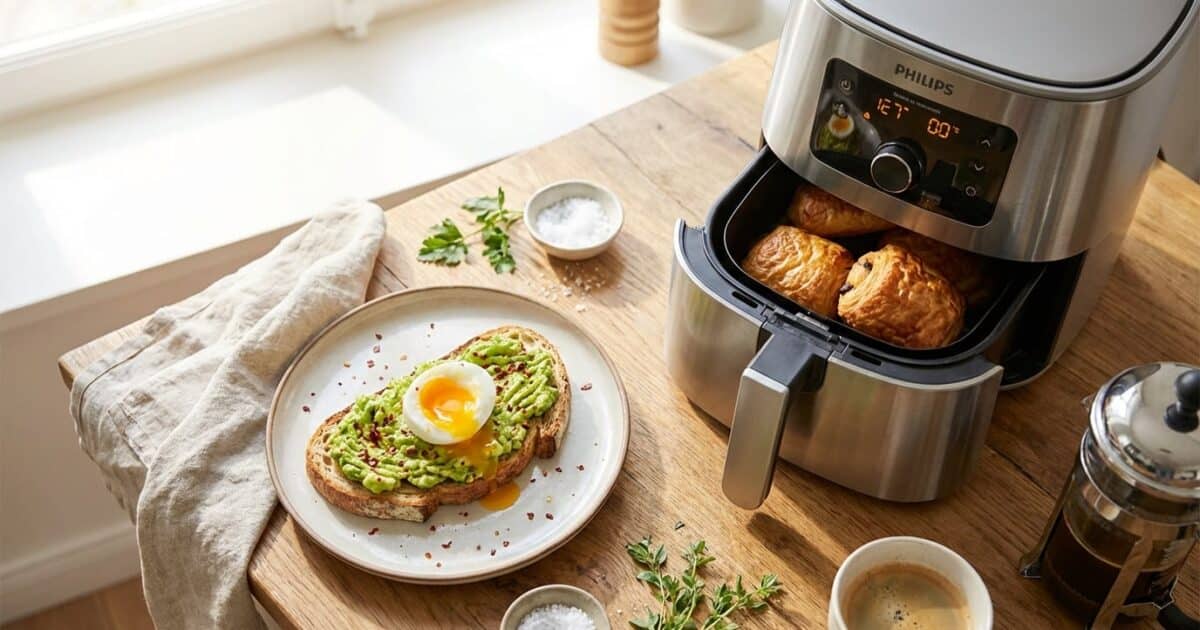
The air fryer soft-boiled egg works particularly well as a topping or centerpiece for simple, bold dishes. One of the most satisfying combinations is crushed avocado on toast: spread ripe avocado on a thick slice of bread, season with olive oil, salt, pepper, and a pinch of chili flakes, then halve the egg over the top and let the yolk run into the avocado. The richness of the yolk ties everything together.
For anyone who enjoys experimenting with eggs beyond the basics, mastering pan technique for fried eggs is the natural next step. And if you're building a full brunch spread, the same attention to detail that goes into timing a soft-boiled egg applies to baking — the kind of precision that separates a dense loaf from a genuinely light, well-textured banana bread.
at 180 °C — the precise window for a runny soft-boiled egg in the air fryer
The air fryer does not reinvent the soft-boiled egg. But it makes a notoriously fussy result reproducible. Choose 180 °C for 6 minutes for a fully liquid yolk, 180 °C for 7 minutes for something creamier, or 130 °C for 9 to 10 minutes if you want a tender, almost silky white. Pull the eggs out, drop them in ice water, and peel. That's the whole method — and it works every time.