
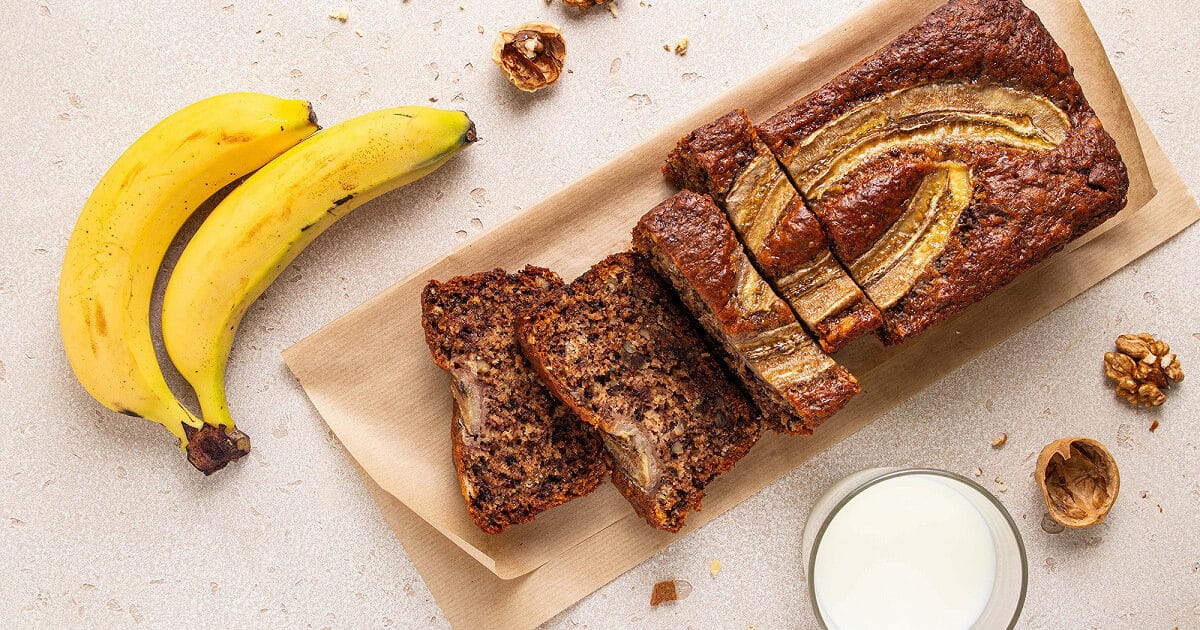
Soft banana bread is one of those recipes that looks simple but often disappoints: too dense, too greasy, too compact. The difference between a dry brick and a genuinely light, moist loaf comes down to five precise adjustments — starting with the bananas themselves.
Banana bread has Anglo-Saxon roots and has become a staple at breakfast, brunch, and afternoon snack tables worldwide. But the most common version people make at home suffers from the same recurring flaws: a heavy hand on the butter, too much sugar, and a batter that ends up more cake-brick than tender loaf. The result is a slice that sits in your stomach rather than melting in your mouth.
The good news is that fixing these problems doesn't require a culinary degree. It requires understanding why they happen — and making five targeted changes.
Ripe bananas are the non-negotiable foundation
The single biggest mistake home bakers make is reaching for yellow, barely-ripe bananas. A soft banana bread depends almost entirely on fruit that has gone well past the point most people would eat it fresh. The bananas you want are the ones with dark brown or black speckled skins, the ones sitting at the bottom of the fruit bowl that look like they should be thrown away.
Why overripe bananas change everything
As a banana ripens, its starches convert to sugars. By the time the skin is heavily spotted, the fruit has become significantly sweeter and far more aromatic. This natural sugar content means you can reduce the added sugar in your recipe without sacrificing flavor. The texture also changes: overripe bananas are softer and blend seamlessly into the batter, creating that characteristic moist, almost fudgy crumb rather than a grainy, dry one.
This is also a practical win. Instead of discarding 3 overripe bananas, you transform them into something worth eating. Waste eliminated, flavor maximized.
Replacing part of the butter with yogurt lightens the texture
The richness problem in banana bread almost always traces back to the fat content. A traditional recipe calls for a generous amount of butter, which contributes tenderness but can easily tip the loaf into territory that feels heavy and greasy. The fix is a partial substitution: replace a portion of the butter with plain yogurt.
Yogurt brings moisture and a slight tang that actually enhances the banana flavor. It also adds a small amount of protein, which helps the structure of the loaf without making it tough.
The ratio doesn't need to be dramatic. Swapping out roughly half the butter for the same volume of yogurt is enough to produce a noticeably lighter crumb. The loaf stays moist, the flavor deepens, and the overall caloric density drops. This single swap addresses both the "too greasy" and "too rich" complaints in one move.
Smart additions that add flavor without weight
Beyond the butter-yogurt swap, there are several clever mix-ins that boost flavor without loading the batter down. A handful of chocolate chips adds pockets of intensity. Chia seeds contribute a subtle crunch and nutritional value without affecting the texture negatively. A pinch of cinnamon or a splash of vanilla extract costs nothing in terms of weight but transforms the aromatic profile entirely. These additions work precisely because they deliver impact in small quantities — the opposite of piling in more fat or sugar.
Mixing the batter correctly prevents a dense, compact loaf
Overmixing is the hidden culprit behind banana bread that comes out dense and almost rubbery. When you work the batter too aggressively, you develop the gluten in the flour, which creates structure where you want tenderness. The goal is a batter that looks slightly rough and uneven, not silky and smooth.
The technique is straightforward: combine your wet ingredients separately, combine your dry ingredients separately, then fold the two together with as few strokes as possible. Stop the moment you no longer see streaks of dry flour. A few lumps are not a problem. They disappear during baking and have zero impact on the final texture.
This principle applies to many baked goods — it's the same logic behind not overworking a muffin batter or a pancake mix. If you've ever wondered why a chef's foolproof technique makes such a difference in simple recipes, it often comes down to understanding when to stop, not when to start.
- Fold wet and dry ingredients together briefly
- Stop as soon as no dry flour is visible
- Accept a slightly lumpy batter
- Beating the batter until smooth
- Using an electric mixer on high speed for the final mix
- Going back and stirring “just a little more”
Getting the baking right preserves the moist crumb
Even a perfectly prepared batter can be ruined in the oven. Banana bread baking requires lower heat and more time than most people expect. A temperature around 160–175°C (320–350°F) for 50 to 65 minutes is typically the right range, though every oven differs. Baking too hot sets the outside before the center has cooked through, which produces that dreaded dense, gummy middle.
How to test for doneness without drying the loaf
The classic toothpick test works, but with a caveat: pull the loaf when the toothpick comes out with just a few moist crumbs attached, not bone dry. A completely clean toothpick often means the loaf has been in the oven slightly too long. The residual heat inside the tin will continue cooking the center for several minutes after you remove it from the oven.
Letting the loaf rest in the tin for 10 minutes before turning it out is not optional. This resting period allows the structure to firm up enough that slicing won't cause the loaf to collapse or crumble. Patience at this stage is what separates a clean, even slice from a broken mess.
Banana bread variations worth exploring once you've mastered the base include a no-added-sugar version for a more natural sweetness, a full-chocolate version for an indulgent twist, and a chia seed version for added texture. Each builds on the same five principles: ripe fruit, lightened fat, minimal mixing, controlled baking, and smart flavoring. The foundation stays the same — what changes is the direction you take it.