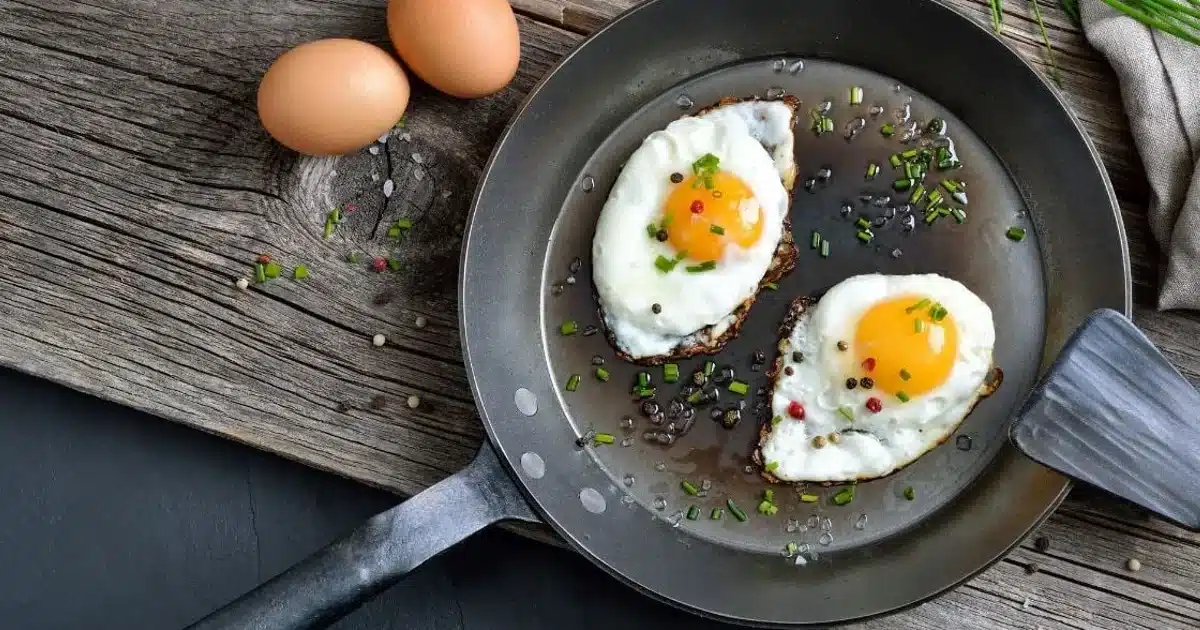
Flour — yes, plain all-purpose flour from your pantry — is the secret to fried eggs that slide cleanly off the pan every single time. No oil, no butter, no scrubbing afterward. Just a light dusting, a properly heated pan, and 3 minutes of cooking. That's all it takes.
Most people have burned an egg at least once. The white carbonizes at the edges, the yolk gets pierced trying to pry the thing loose, and the pan ends up soaking in the sink. It happens more often than anyone admits — roughly one time in three, according to the Instagram account @jimmy_laura_astuces, run by Jimmy and Laura, who popularized this flour-based technique online. The fix is simpler than any non-stick spray or specialty cookware.
Flour as a non-stick barrier actually works
The logic behind this trick is straightforward. Flour, when spread in a thin, even layer across the bottom of a dry pan, creates a physical barrier between the egg white and the hot metal surface. The proteins in the egg white never make direct contact with the pan, so they can't bond to it. The result is an egg that lifts off cleanly, with a slightly crisp underside and a white that stays silky rather than rubbery.
Why oil and butter aren't always enough
Oil and butter work — until they don't. A pan that isn't hot enough when the egg goes in causes the white to spread too wide and then contract unevenly as it cooks. Too much heat burns the fat before it can do its job, leaving the white stuck and browned at the edges while the center stays undercooked. Butter in particular can go from golden to scorched in seconds, and once it does, the egg sticks regardless. The flour method removes this variable entirely. There's no fat to manage, no temperature window to hit precisely for the coating to work.
The texture difference is real
With the flour technique, the fried egg develops a gently crisp bottom — not greasy, not rubbery — while the yolk stays runny and the white remains tender. Without it, even when oil is used correctly, the texture can veer toward dense and compact, especially if the egg sits in the pan even 30 seconds too long. Cooking time matters here: 3 minutes maximum is the recommended window. Beyond that, the yolk sets and loses its characteristic flow.
Always make sure the pan is sufficiently heated before adding the flour. A cold pan will cause the flour to clump rather than form an even barrier, and the egg may still stick.
The exact technique, step by step
The method shared by Jimmy and Laura on @jimmy_laura_astuces requires no special equipment and no exotic ingredients. Here's how it works:
- Heat the pan over medium heat until it's properly hot before doing anything else.
- Sprinkle a small amount of flour — plain all-purpose flour — across the bottom of the pan.
- Spread it evenly using a brush or simply by tilting the pan so the flour coats the surface uniformly.
- Crack the egg directly onto the flour layer.
- Cook for no more than 3 minutes, keeping the heat at medium to avoid burning the flour underneath.
That's the entire process. No oil, no butter, no cooking spray. The egg slides off when ready, leaving almost no residue behind. If you've been dealing with a pan that's seen better days, it's also worth checking whether the surface itself is the problem — worn non-stick coating can make even the best technique fail.
maximum cooking time for a perfect fried egg with this flour method
What goes wrong without this trick
Understanding why eggs stick in the first place makes the flour solution feel less like a hack and more like applied kitchen science. When a raw egg white hits a hot metal surface, the proteins denature rapidly and form bonds with the pan's surface. The hotter and more uneven the surface, the stronger those bonds. Oil creates a fluid layer that prevents direct contact, but it requires precise heat management. Flour does the same job mechanically, without the need for temperature precision.
A pan that's too cold when the egg goes in creates a different problem: the white spreads out thin, runs into every scratch and imperfection in the surface, and then contracts as it heats up. That contraction is what tears the white apart and makes it nearly impossible to lift without breaking the yolk. The flour barrier prevents this spreading entirely, keeping the egg compact and intact from the moment it hits the pan.
For anyone who regularly experiments with eggs in other forms, this kind of attention to technique pays dividends across the board. Knowing how egg yolk changes color during hard-boiling or understanding the best way to cook eggs for vitamin D absorption all point to the same underlying principle: small variables in cooking method produce dramatically different results.
Flour replaces fat without sacrificing flavor
One concern people raise immediately is whether flour leaves a taste or a chalky residue on the egg. In practice, the quantity used is so small — just enough to coat the pan's surface — that it becomes virtually undetectable once the egg is cooked. The flour toasts lightly during cooking, contributing at most a faint nuttiness that most people would never identify without knowing it was there.
A fat-free fried egg that still satisfies
Removing oil or butter from the equation also changes the nutritional profile of the dish slightly. For anyone reducing fat intake without wanting to sacrifice the pleasure of a properly cooked fried egg, this method delivers exactly that. The egg cooks in its own moisture, the white sets cleanly, and the yolk stays at the soft, runny stage that makes a fried egg worth eating in the first place.
Pairing ideas for a complete meal
A fried egg cooked this way works just as well as a topping for grain bowls — the kind of rice bowl with sautéed vegetables that makes a fast, balanced weeknight meal — as it does on its own with toast. And if you're already exploring other egg cooking methods, this flour trick slots naturally into a broader repertoire of techniques that prioritize texture and simplicity over complicated prep. The pantry ingredient was there all along. It just needed the right application.