
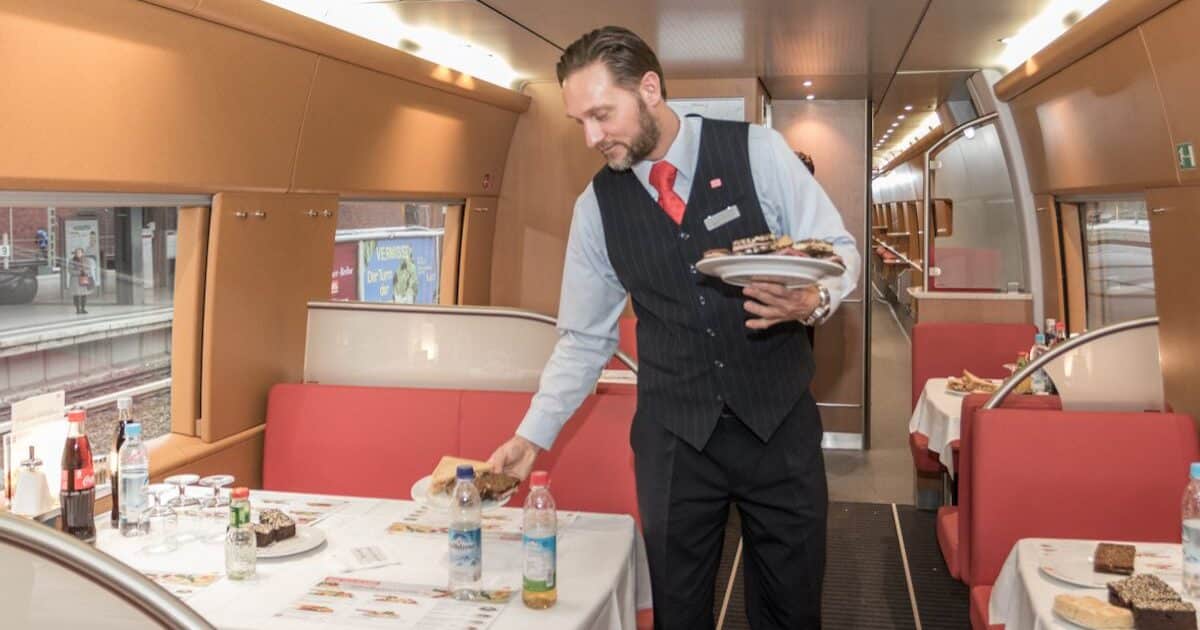
A LNER catering employee, Peter Duffy, was dismissed for gross misconduct after retrieving discarded sausage rolls from a train's kitchen bin, reheating them, and having a colleague serve them to first-class passengers on 7 May 2023. His two subsequent employment tribunal claims were both rejected.
The story reads like a cautionary tale about misguided customer service instincts colliding head-on with food hygiene law. On board a London North Eastern Railway train departing from York, a simple stock shortage spiraled into a disciplinary case that would cost a man his job and land him in a Newcastle tribunal more than two years later.
What makes this case unusual is not the scale of the incident — just two passengers were affected — but the reasoning offered by the employee at the center of it all.
The sausage rolls that ended a career
Peter Duffy worked as a catering host for LNER, the British rail operator running services across the north and east of England. On the evening of 7 May 2023, the train's first-class kitchen ran out of sausage rolls. Rather than inform passengers that the item was unavailable, Duffy retrieved discarded pastries from the bin, reheated them, and arranged for a colleague to serve them to two first-class passengers.
The incident did not go unnoticed. A colleague who had walked into the kitchen at the time later described the moment: "A standard class host and I had gone into the kitchen to prepare something to eat when the host who was cooking told us that the sausage rolls had ended up in the bin." That account, combined with CCTV footage reviewed during the internal investigation, provided the evidence base for what followed.
Serving food that has been discarded — even briefly — constitutes a breach of food hygiene standards in the UK. Once food enters a waste bin, it is no longer considered safe for consumption, regardless of its original packaging or condition.
Duffy's own explanation
When confronted during the 17 May 2023 inquiry meeting, Duffy did not deny the facts. He offered a rationale that was, in its own way, coherent: "I clearly retrieved them because there were none left for first-class passengers, but they were wrapped in foil. We were out of stock." He went further, characterizing himself as "a person who goes above and beyond for his clients" and insisting he was "simply trying to do his best for the customer."
The argument did not hold. LNER concluded that wrapping in foil did not render discarded food safe for service, and that the decision to retrieve bin waste for passenger consumption constituted gross misconduct. Duffy was dismissed in July 2023.
The tribunal rejected both claims
Following his dismissal, Duffy filed two separate claims before the employment tribunal in Newcastle: one for unfair dismissal, one for discrimination. Both were rejected.
The tribunal's decision effectively validated LNER's handling of the case, confirming that the company had reasonable grounds to treat the incident as gross misconduct and that the dismissal was procedurally sound. The discrimination claim, the details of which were not disclosed in the source reporting, was similarly unsuccessful.
tribunal claims filed by Peter Duffy — both dismissed by the Newcastle employment tribunal in August 2025
The timeline is worth noting. The facts occurred in May 2023. The dismissal followed in July 2023. But the tribunal proceedings were not concluded until August 2025, meaning the case stretched over more than two years before reaching its final outcome.
What CCTV evidence meant for the case
The role of surveillance footage in this case is significant. Witness testimony alone might have been challenged or disputed, but the combination of a colleague's direct account and camera evidence left little room for alternative interpretations. Food safety violations on commercial transport are precisely the kind of incidents that internal CCTV systems are designed to capture, and in this instance, the footage proved decisive in establishing what had happened in the kitchen.
Food hygiene standards on commercial transport
This case touches on a broader issue in the food service industry: the gap between good intentions and regulatory compliance. Duffy's stated motivation, avoiding a stock shortage and keeping first-class passengers satisfied, is understandable from a customer service perspective. But food hygiene regulations in the UK do not include an exception for well-meaning employees under stock pressure.
Once food has been discarded, it cannot legally re-enter the service chain. The reasons are straightforward: temperature control cannot be verified after disposal, potential contamination from the bin environment cannot be ruled out, and the passenger consuming the food has no way of knowing its history. The fact that the sausage rolls were wrapped in foil, as Duffy emphasized, is irrelevant from a regulatory standpoint.
Proper food handling on trains, airlines, and other transport catering operations follows the same HACCP-based frameworks that govern restaurants and food manufacturers. Understanding how to safely handle and store food matters as much in a moving kitchen as in a fixed one. The same logic applies to temperature management: reheating discarded food does not eliminate all risks, particularly if the item passed through an unsafe temperature zone during its time in the bin.
LNER operates long-distance rail services between London and destinations in the north and east of England, including Edinburgh. First-class catering is a premium service feature, and food hygiene compliance is part of the operator’s contractual and regulatory obligations.
The two passengers who were served the retrieved sausage rolls may never have known what they were eating. No health consequences were reported in the available information. But the potential risk to passenger health was cited as part of the rationale for treating the matter seriously, and LNER's swift response, suspension of both employees involved and an immediate internal inquiry, reflected that assessment.
Duffy's case ultimately illustrates a tension that many hospitality workers recognize: the pressure to deliver seamless service, even when supplies run short. But in a regulated food environment, improvising with bin waste is not a workaround. It is a violation. And as the Newcastle tribunal confirmed, no amount of customer-first attitude changes that fact.
For anyone working in food preparation and service, the lesson is blunt: when stock runs out, the correct response is to tell the customer, not to find an alternative that bypasses every hygiene rule in the book.