
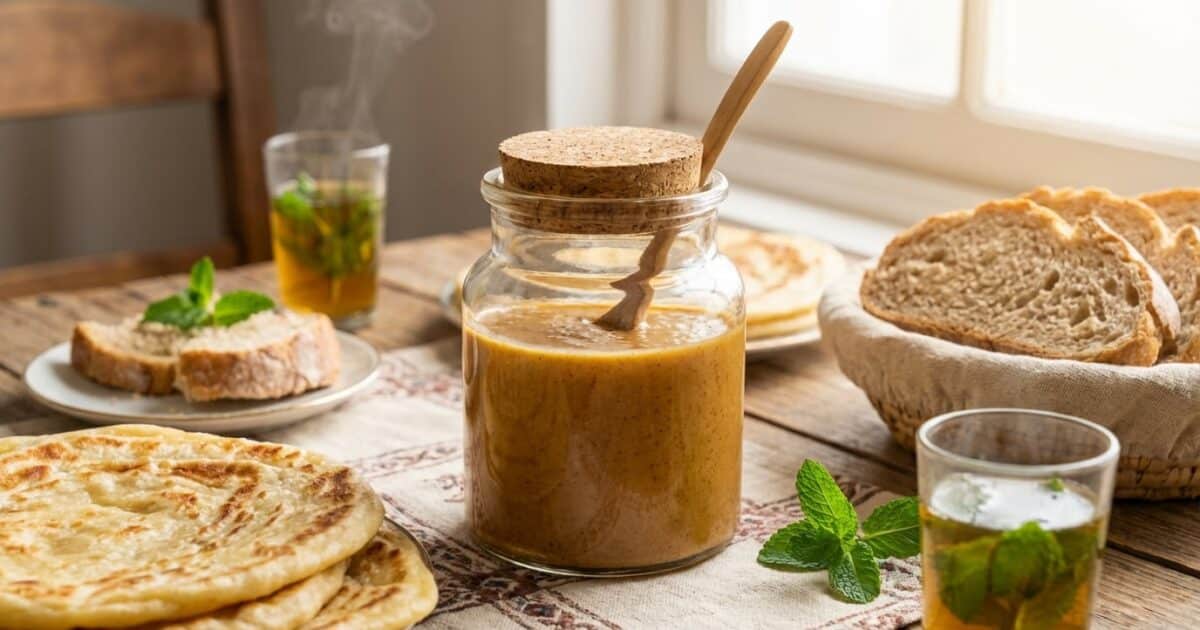
Amlou is a traditional Moroccan almond spread from the Souss region in southern Morocco. Made with just three core ingredients — roasted almonds, argan oil, and honey — this naturally additive-free paste has earned the nickname "Moroccan Nutella" and delivers a rich, nutty depth that commercial spreads simply cannot match.
If you've ever stood in a Moroccan kitchen at breakfast time, you know the ritual. Warm bread, a pot of mint tea, and a small dish of something dark, glossy, and impossibly fragrant. That's amlou. And once you've tasted it, the jar of industrial hazelnut spread at the back of your cupboard starts to feel like a compromise.
The recipe below, spotted on the Instagram account Happycook.fr and referenced by Marmiton, brings this regional specialty within reach of any home kitchen.
Amlou comes straight from southern Morocco
The Souss region, nestled in the south of Morocco, is the birthplace of amlou. It's a land of argan trees, almond orchards, and beekeeping traditions — which explains perfectly why those three ingredients became the foundation of a single, iconic preparation. Locally, amlou has been served at breakfast and at tea time for generations, spread generously over warm bread or alongside thin crêpes.
The global spread of Moroccan cuisine has introduced amlou to a wider audience, much like authentic Moroccan harira has traveled far beyond its origins. But amlou remains less known than it deserves, partly because quality argan oil — the ingredient that makes it irreplaceable — was long difficult to source outside Morocco. That's no longer the case.
A three-ingredient paste with serious depth
The beauty of amlou lies in its simplicity. 200 g of whole almonds, 150 ml of food-grade argan oil, and 3 tablespoons of honey. A pinch of fleur de sel rounds everything out. No emulsifiers, no refined sugar, no palm oil. The flavor comes entirely from the quality of each component, which means choosing a good argan oil matters enormously. Its slightly smoky, earthy character is what separates amlou from any other nut butter on the market.
The step-by-step amlou recipe
The process is straightforward, but two stages deserve attention: the roasting and the blending.
Start by dry-roasting the 200 g of whole almonds in a pan over medium heat for 5 to 6 minutes, stirring regularly, until they turn golden and release their oils. Don't rush this step. The toasting is what develops the nutty complexity that defines the finished spread. Let them cool slightly before moving on.
Transfer the almonds to a food processor and blend for approximately 5 minutes until the mixture reaches a thick, grainy paste — what bakers sometimes call a "fat powder." At this point, the almonds have broken down enough to release their natural oils, but the texture is still coarse.
Blending to a smooth, spreadable consistency
Add the 150 ml of argan oil, the 3 tablespoons of honey, and the pinch of fleur de sel directly to the processor. Blend again for another 5 minutes, scraping down the sides as needed, until the paste becomes smooth and homogeneous. The final texture should be thick but spreadable — denser than a vinaigrette, looser than peanut butter.
Food-grade argan oil (huile d’argan alimentaire) is different from cosmetic argan oil. Always check the label before purchasing — only the edible version should be used in this recipe.
Transfer the finished amlou into a clean glass jar, seal it well, and store it away from light at room temperature. It keeps for at least one month without refrigeration.
How to use and store your amlou
Amlou is traditionally served at breakfast or tea time, spread over warm bread or crêpes. But its uses extend well beyond the Moroccan table. A thin layer works beautifully on pancakes, brioches, or even stirred into a bowl of porridge or plain yogurt. The key word is "thin" — this spread is very calorie-dense and rich in healthy fats, so a little goes a long way. Think of it the way you'd think about a good tahini or a premium nut butter: a condiment, not a filling.
One practical note on storage: over time, a film of oil may rise to the surface of the jar. This is completely normal and not a sign of spoilage. Simply stir the paste back together with a clean, dry spoon before using. Always use a dry utensil — introducing moisture into the jar shortens its shelf life significantly.
- No added sugar or artificial additives
- Rich in healthy fats from almonds and argan oil
- Stores for at least one month at room temperature
- Versatile: works on bread, crêpes, yogurt, porridge
- Very calorie-dense — portion control matters
- Oil separation occurs over time
- Quality depends heavily on the argan oil used
Amlou as an everyday alternative to commercial spreads
The contrast with industrial spreads is stark. Where most commercial options rely on refined sugars, hydrogenated fats, and flavor enhancers, amlou delivers its energy and taste through whole ingredients alone. The almonds provide protein and fiber alongside their fats. The honey brings natural sweetness without glycemic spikes comparable to refined sugar. And the argan oil contributes a nutritional profile that few other cooking oils can rival.
For anyone already interested in homemade baked goods — like a well-made banana bread — amlou makes a natural companion. It spreads cleanly, pairs with both sweet and lightly savory bases, and brings a distinctly North African character to an otherwise ordinary breakfast table. The recipe takes roughly 20 minutes from start to finish, and the result is a jar of something genuinely hard to find outside Morocco. That alone makes it worth the effort.