Freezing eggs is entirely possible, safe, and practical, but only if you follow a few non-negotiable rules. The shell must never go into the freezer, preparation methods differ depending on whether you're working with whole eggs, whites, or yolks, and thawing has exactly one correct approach.
Most people assume eggs can't be frozen. That assumption is wrong, but it comes with an asterisk: you can't freeze them whole in their shell, and you can't treat them like a block of ice cream. The biology of an egg demands a bit more care.
Eggs are a staple in everything from morning scrambles to baked goods like a moist banana bread or a rich custard tart. Knowing how to preserve them properly means less waste, more flexibility, and no unnecessary food safety risks.
Why you must never freeze eggs in the shell
This is the one absolute rule, and the reason is straightforward physics. When water freezes, it expands. The liquid inside an egg is no exception. At -18 °C, the contents of a whole egg in its shell will swell, crack the shell, and create microscopic openings that allow bacteria, including salmonella, to enter.
A cracked egg in your freezer isn't just a mess. It's a genuine health hazard. Freezing at -18 °C blocks the growth of microorganisms, but it does not sterilize. Bacteria that were present before freezing will resume activity once the egg warms up. A contaminated egg that thaws at room temperature is exactly the kind of scenario food safety guidelines exist to prevent.
The solution is simple: always crack your eggs before freezing them.
The shell cracks as the liquid expands at -18 °C, creating entry points for bacteria including salmonella. Always crack and prepare eggs before placing them in the freezer.
How to freeze raw eggs correctly
Freezing whole beaten eggs
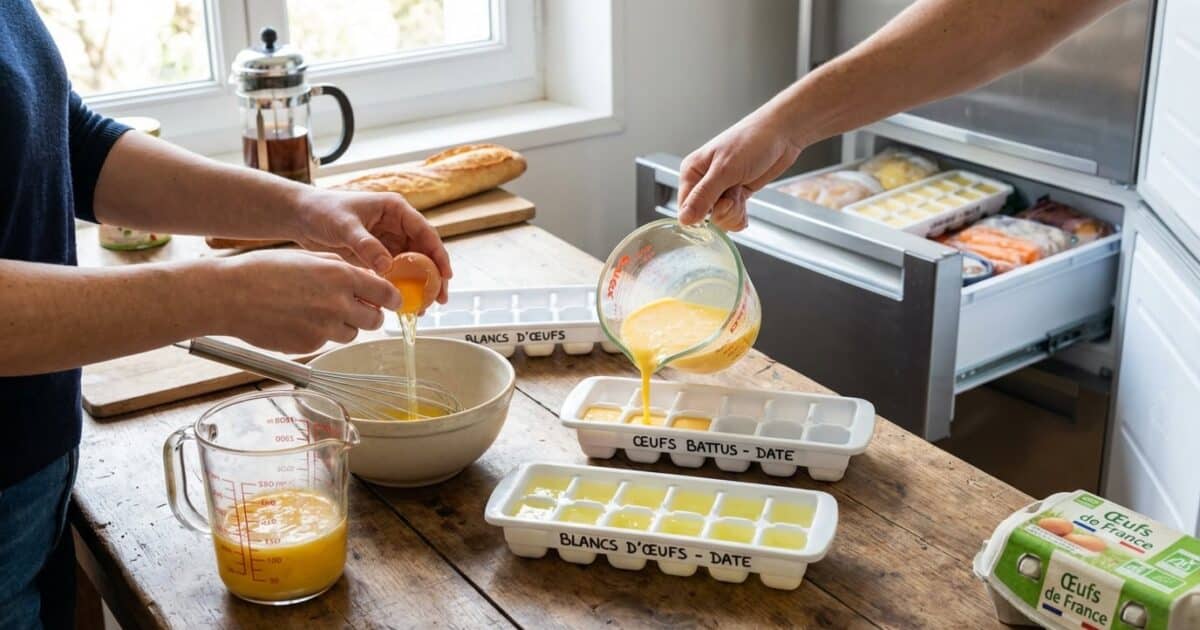
The most versatile method is also the simplest. Crack your eggs into a bowl, beat them lightly with a fork until the yolk and white are just combined, then pour the mixture into a bac à glaçons (ice cube tray) or small airtight containers. One cube typically equals one egg, which makes portioning effortless later.
Labeling is not optional. Write the date and the number of eggs on each container. Eggs look identical frozen, and you will forget. The recommended storage window is 4 months, with a maximum of 6 months if conditions are ideal. Beyond that, quality degrades noticeably even if safety isn't necessarily compromised.
Freeze your eggs before the use-by date, never after. This matters because freezing pauses deterioration, it doesn't reverse it.
Freezing egg whites and yolks separately
Egg whites are the easiest component to freeze. They require no preparation at all. Separate them cleanly, pour them into an airtight container, and freeze. Their structure survives the process remarkably well, making them ideal for meringues, soufflés, or any recipe where texture matters.
Yolks are trickier. Raw egg yolks frozen without any treatment undergo a process called gelification: the proteins tighten and the yolk becomes dense and gummy once thawed, making it nearly unusable. The fix is to add either a pinch of salt (for savory applications like quiches or sauces) or a small amount of sugar (for pastry, crème brûlée, or custards) before freezing. This disrupts the gelification mechanism and keeps the yolk workable after thawing.
Freezing cooked eggs: what works and what doesn't
What survives the freezer well
Scrambled eggs and omelettes freeze with minimal quality loss. Cook them slightly underdone, let them cool completely, wrap them tightly, and freeze. Once thawed, they work well reheated in a hot sandwich, tossed into a vegetable stir-fry, or used as a quiche filling. Storage time for cooked frozen eggs is shorter, just a few weeks, before the texture starts to suffer.
If you enjoy cooking egg-based dishes, this technique pairs well with other kitchen efficiency habits, like preparing a batch of harira soup that also freezes beautifully.
What doesn't survive the freezer
Hard-boiled eggs are the clear loser here. The white turns rubbery and the yolk develops a dry, chalky texture that coats the mouth unpleasantly. There's no preparation trick that fixes this. If you've hard-boiled too many eggs, use them within the week rather than attempting to freeze them.
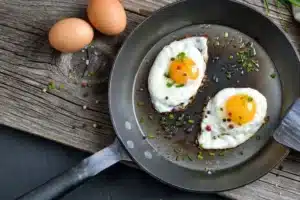
Cooked egg whites in general become elastic and chewy after freezing, which is why fried eggs and poached eggs are also poor candidates. If you're looking to perfect your technique with eggs before you even get to storage, learning how to stop eggs sticking to the pan is a useful starting point.
- Lightly beaten whole raw eggs
- Raw egg whites (no prep needed)
- Raw yolks with salt or sugar added
- Scrambled eggs and omelettes (slightly undercooked)
- Whole eggs in their shell
- Hard-boiled eggs (rubbery white, chalky yolk)
- Fried or poached eggs
- Raw yolks with no treatment
The only safe way to thaw frozen eggs
Thawing is where many people make avoidable mistakes. There is one correct method: place the frozen eggs in a closed container in the refrigerator overnight, at a temperature below 4 °C. The slow, cold thaw keeps the eggs in a safe temperature zone throughout the process.
Thawing at room temperature is not acceptable. As the outer layer warms while the center remains frozen, you create pockets of egg sitting at temperatures favorable to bacterial growth. The same problem applies to microwave thawing, which can partially cook the egg in uneven bursts, creating warm zones that accelerate microbial activity.
Once thawed, use the eggs within 24 hours. Do not refreeze them. This 24-hour window applies to both raw and cooked frozen eggs. After that point, quality and safety both decline.
Thaw frozen eggs overnight in the refrigerator at under 4 °C, always in a sealed container. Use within 24 hours. Never refreeze, never thaw at room temperature or in the microwave.
Thawed raw eggs are best directed toward baking, quiches, and well-cooked custards rather than soft scrambles or lightly cooked preparations. The texture after freezing is slightly altered, and high-heat applications that fully cook the egg mask that difference most effectively. Thawed egg whites still whip reasonably well for meringues, provided they've been stored cleanly and used promptly. The 4-month mark remains the practical cutoff for best results, even if the eggs technically remain safe up to 6 months at a stable -18 °C.