A fried egg that sticks to the pan is one of the most frustrating everyday kitchen problems. A TikTok creator named Jimmy has a fix that requires exactly one ingredient — flour — and zero butter or oil. The egg slides straight onto the plate, yolk perfectly intact.
Every home cook has been there. You crack an egg into a hot pan, and within seconds it's welded to the surface. You reach for the spatula, you pry, you tear. The yolk breaks. Breakfast is ruined. And somehow, adding more butter or oil never seems to solve the problem consistently.
Jimmy, the creator behind the @jimmy_laura_astuces account on social media, demonstrated a technique in a short video that has since been tested and validated by an editorial team. The method is disarmingly simple. But the science behind it is solid, and the result speaks for itself.
Flour is the only ingredient you need
Forget butter. Forget olive oil. The secret to a fried egg that doesn't stick is a single pinch of flour, spread across the dry pan before anything else goes in.
The logic is straightforward. When flour hits a hot pan, it forms a thin, dry film between the metal surface and the egg white. That film acts as a physical barrier. The egg never actually makes direct contact with the pan, so there's nothing for the proteins in the white to bond to. The result is an egg that cooks cleanly and releases on its own.
This technique works with any standard pan, including stainless steel — the surface type notorious for sticking. No non-stick coating required.
Why butter and oil fall short
Butter burns quickly at high heat, and when it does, it creates a sticky residue rather than a protective layer. Olive oil behaves similarly — it can smoke and polymerize onto the pan surface, which actually makes sticking worse over time. Jimmy's flour method bypasses this entirely. No fat, no smoke, no mess.
The flour film explained
The barrier created by flour is purely mechanical. A small pinch of flour, distributed evenly across the pan surface and then lightly wiped with a paper towel to remove any excess, leaves just enough material to prevent adhesion. The egg white, which solidifies rapidly on contact with heat, sets against the flour layer rather than the metal. Once cooked, the egg glides freely.
The step-by-step method behind the technique
Jimmy's video lays out the process in a clear sequence. There's no guesswork involved, and no special equipment beyond a pan, a paper towel, and a pinch of flour.
Here are the steps exactly as demonstrated:
- Add a small pinch of flour to a dry pan (no oil, no butter)
- Spread the flour evenly across the surface
- Wipe away the excess with a paper towel
- Crack the eggs directly into the pan
- Cook over medium-high heat
- Remove from heat when the white is completely opaque
- Slide the egg directly onto the plate — no spatula needed
The detail about the paper towel matters. Too much flour and you get a powdery residue on the underside of the egg. The goal is a barely-there coating, not a dusting. Once you've wiped the pan, it should look almost clean.
single ingredient needed — just a pinch of flour
Heat control determines the final result
Medium-high heat is the specified setting, and it matters more than most people realize. Too low, and the egg steams rather than sets — the white stays translucent and gelatinous, and the flour film doesn't activate properly. Too high, and the edges of the white turn crispy and brown before the center is cooked through.
Medium-high heat strikes the balance. The flour film sets quickly, the white firms up from the outside in, and by the time the white is fully opaque, the yolk is still runny and the egg is ready to plate. No spatula required — the egg simply slides off when you tilt the pan.
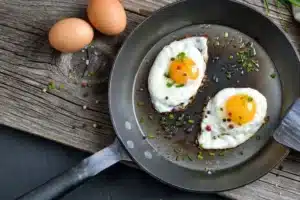
This is the benchmark for a perfect fried egg: white fully cooked, yolk intact and liquid, no tearing, no sticking. The flour technique consistently delivers that result in a way that butter and oil simply don't.
The egg is ready to plate when the white is entirely opaque — no transparent or jiggly sections remaining. At that point, tilt the pan and it slides off on its own.
What "validated by the editorial team" actually means
The technique wasn't just shared and forgotten. The editorial team behind the article tested it independently before publishing. That distinction separates a viral trick from a genuinely reliable method. Many social media cooking hacks look convincing on video and fail in practice. This one held up. The egg released cleanly, the yolk stayed whole, and the pan required almost no cleaning afterward — a secondary benefit worth mentioning.
Cooking fundamentals often come down to small adjustments with outsized effects. Understanding how temperature affects what you're cooking — whether it's beer service or egg cookery — is the kind of knowledge that compounds over time. And much like knowing the difference between fermentation styles changes how you appreciate a drink, understanding why flour prevents sticking changes how you approach the pan entirely. The technique works because of the barrier, not despite the absence of fat. Once you understand that, you stop reaching for the butter by reflex.