Vanilla crème brûlée is one of French cuisine's most iconic desserts — and one of the simplest to master at home. With just four ingredients, 30 minutes in the oven, and a quick blast of caramelized sugar on top, you can serve a restaurant-worthy dessert that will genuinely impress every guest at your table.
Few classic desserts deliver this kind of payoff for so little effort. The silky custard, the crackling caramel crust, the unmistakable scent of real vanilla — this is a recipe that belongs in every home cook's permanent rotation.
Vanilla crème brûlée starts with the right ingredients
The ingredient list for this dessert is deliberately short: 50 cl of full-fat liquid cream, 4 egg yolks, 80 g of caster sugar, and a vanilla pod. That's it. But within that simplicity, a few choices make or break the final result.
Real vanilla, not extract
Skip the vanilla extract entirely. Liquid vanilla flavoring simply doesn't have the depth or aromatic punch needed to perfume a cream-based custard properly. A real vanilla pod, split lengthwise and scraped, infused directly into the warm cream alongside the whole pod, delivers an intensity that no bottled shortcut can replicate. The entire pod goes into the saucepan — not just the seeds — to extract every last bit of flavor during the infusion.
Full-fat cream, no substitutions
This is not the recipe to lighten up. Full-fat liquid cream is what gives crème brûlée its signature density and smoothness. Lower-fat alternatives won't set correctly in the oven, and the texture will suffer. The richness here is the whole point.
Regular caster sugar is not suitable for the caramelization step — it won’t brown properly under the heat. Always use brown sugar (cassonade) for the final crust.
The technique that makes this recipe foolproof
The method here is classic, but every step serves a purpose. Skipping or rushing any of them changes the outcome.
Step-by-step: from cream to custard
Start by preheating the oven to 150°C. While it warms up, heat the cream in a saucepan with the split vanilla pod and its scraped seeds. In a separate bowl, whisk the 4 egg yolks with 80 g of sugar until the mixture turns pale and slightly thick. Remove the vanilla pod from the hot cream, then pour the cream gradually over the egg and sugar mixture, stirring vigorously to avoid scrambling the eggs. Divide the mixture evenly between 4 individual ramekins.
The bain-marie: non-negotiable
Here's where a lot of home cooks go wrong. The ramekins must be placed inside a large oven dish, then surrounded with water poured to mid-height of the ramekins. This water bath is not optional — it regulates the oven's heat around the custard, preventing the eggs from cooking too fast or curdling. Without it, the texture turns grainy rather than smooth. Bake for exactly 30 minutes, then let the custards cool before transferring them to the refrigerator for at least 30 minutes.
If you enjoy perfecting egg-based techniques in the kitchen, understanding how egg yolk chemistry works can help you make better decisions across many recipes — not just crème brûlée.
Caramelizing the sugar: chalumeau or oven grill
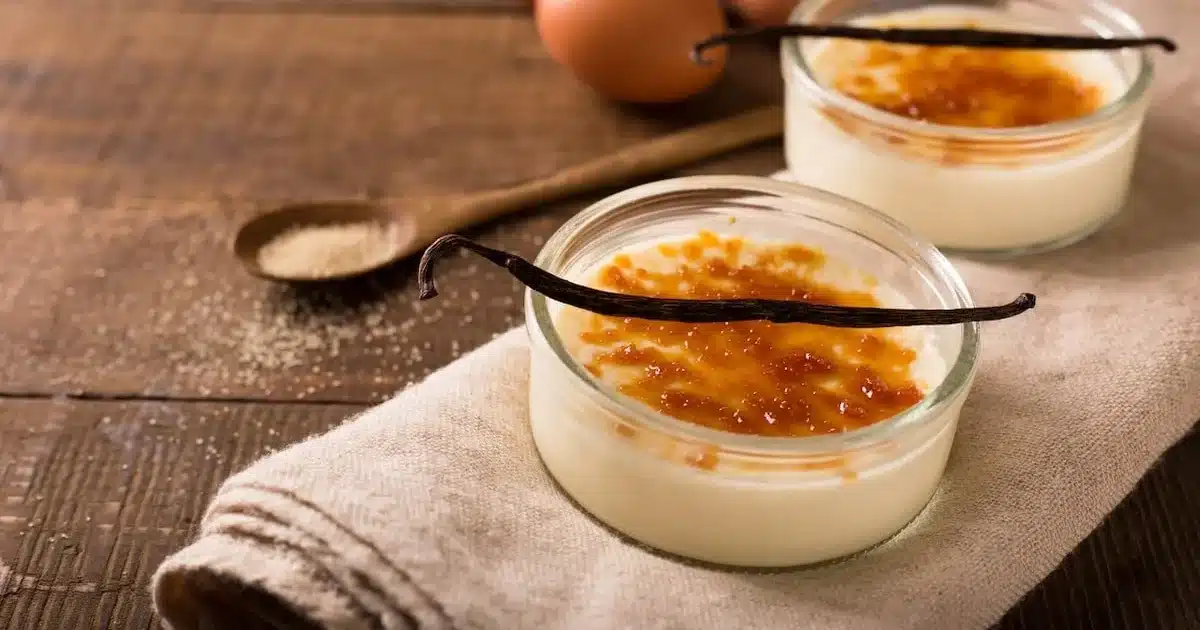
Once the custards are fully chilled and set, sprinkle a thin, even layer of cassonade (brown sugar) over the surface of each one. The caramelization step is where the magic happens — and where the dessert earns its name.
A kitchen torch (chalumeau) is the classic tool. Hold it close, move it in small circles, and watch the sugar bubble and darken into a deep amber crust. If you don't own a torch, the oven grill works as a substitute: slide the ramekins under a preheated broiler for a few minutes, watching closely to avoid burning. The result won't be quite as even, but it gets the job done.
One rule applies regardless of method: serve immediately after caramelizing. The crust softens as it sits, and that satisfying crack when a spoon hits the surface is only available in the first few minutes after torching.
in the oven at 150°C is all it takes to set a perfect vanilla custard
Creative variations to explore beyond the classic
The vanilla crème brûlée recipe is a foundation, not a ceiling. Once you've nailed the base technique, the flavor variations are almost endless — and many of them require nothing more than swapping the infusion ingredient.
Coffee crème brûlée works by steeping ground coffee in the hot cream before straining. Pistachio adds a nutty depth. Speculoos (Belgian spiced biscuits) crumbled into the cream creates a warming, spiced version perfect for autumn. Citrus variations — orange, lemon — bring brightness and acidity that cut through the richness beautifully. For something more tropical, coconut milk can replace part of the cream, and banana slices make a striking garnish on top.
And then there are the savory applications. Crème brûlée technique translates surprisingly well to savory preparations: foie gras crème brûlée is a well-established French starter, and butternut squash versions have become a modern bistro staple. The bain-marie method and the custard ratio remain the same — only the flavorings change.
For another quick and indulgent dessert that doesn't require much prep, these giant cookies with melting centers are ready in 12 minutes and follow a similarly simple logic. And if you're planning a full dinner party spread, a comforting family dish like mustard tenderloin also clocks in at around 30 minutes — making it an ideal main course before this dessert.
Four ingredients, one bain-marie, one vanilla pod — the homemade crème brûlée recipe is proof that the most elegant French desserts are often the most accessible. Master the method once, and you’ll have a reliable showstopper for every occasion.
The beauty of this dessert is that it scales effortlessly. The base recipe yields 4 crème brûlées, but doubling it for a dinner party requires no extra technique — just a larger oven dish for the bain-marie. Whether you stick to the classic vanilla or start experimenting with coffee, citrus, or spiced variations, the fundamentals stay the same: good cream, real vanilla, a patient oven, and a proper caramel crust served the moment it sets.